
Baker County Court Records After a Jail Arrest
An arrest in Baker County starts a chain that ends in a court file. The deputy or officer books the person at the jail. The booking charge is just a starting point. It rests on probable cause, and it can change. The State Attorney for the Eighth Judicial Circuit then reviews the case. That office, not the sheriff, decides what charges to file in court. When the prosecutor files, a case opens and the court record begins. From that point, the court records after the arrest carry the case number, the filed counts, the bond, the hearings, and the outcome.
Two systems hold two different stories. The jail side covers custody and booking. For who is in custody and the booking detail, the jail inmate records page is the right tool, and booking photos live on the jail mugshots page. The court side covers the case. The court records after an arrest show the charges the prosecutor actually filed, which can differ from the booking charge. Keep the two apart. The roster will not list court dates, and the court file will not track jail housing.
How to Find Baker County Court Records After an Arrest
Court records after a Baker County arrest run through the Baker County Clerk of Court and the Online Court Records Search portal. The sheriff points the public the same way. Its Corrections FAQ says to contact the Baker County Clerk of Court for a county inmate court date or to use the Baker County OCRS site at Civitek. The state portal does not open a county file right away. You must pick the county first, then run the case or name search inside that county session.
The Civitek portal starts at a county selector screen. You choose the right county there before any case search is allowed.
The selector page can be reached at the Online Court Records Search county selector, where Baker County appears in the dropdown.
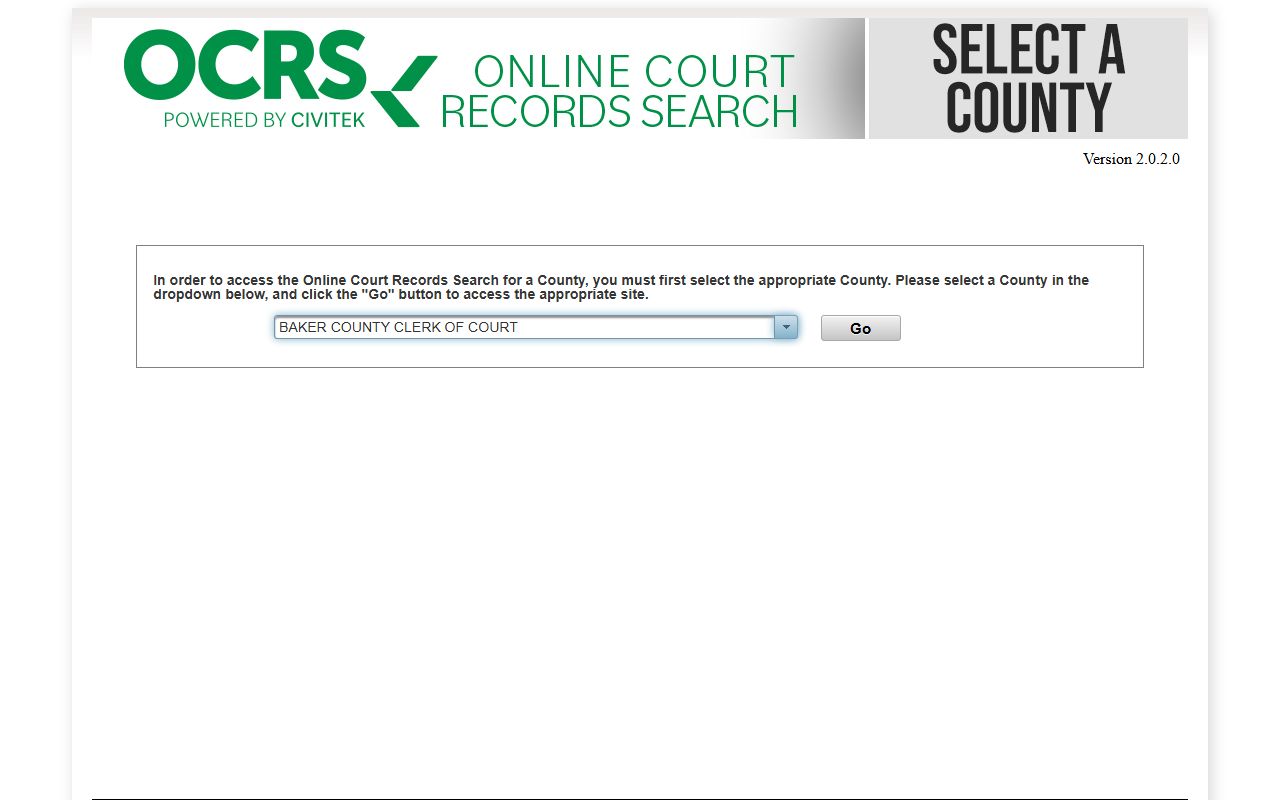
The screen carries the title Online Court Records Search and asks you to pick a county and click Go. That step locks the session to Baker County and unlocks the search fields for that clerk.
- Open the Civitek OCRS county selector and choose "BAKER COUNTY CLERK OF COURT," then click the Go button to enter the county session.
- In the Baker case-search app, search by the defendant name or by the case number if you already have it.
- Open the matching case and read the charge list, the filing date, and the assigned division.
- Check each charge for its code, its level, and its current status, plus any bond order or court date on the docket.
The case search app itself loads after the county step. It needs a live county session to show the full set of search fields.
The interface is shown on the Baker County court case-search app, which opens once a county is selected.
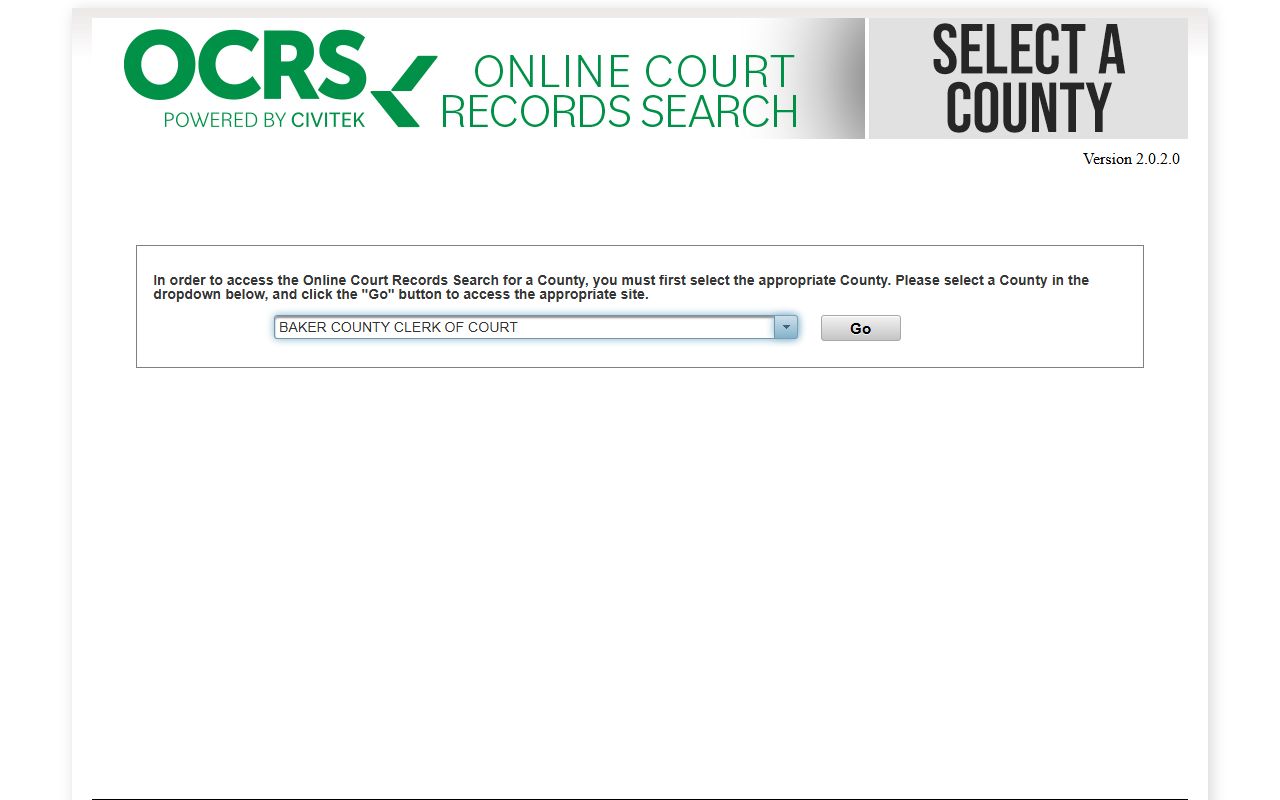
From this app you pull the case number, the filed charges, the court dates, and the disposition. For a statewide criminal-history product rather than one local docket, that data falls under a separate state law, covered further down.
How Baker County Charges Get Filed After an Arrest
Walk the path from the arrest forward. The jail books the person and logs a booking charge. The court record does not truly begin until the state files a charging document. In Baker County the State Attorney for the Eighth Judicial Circuit handles that step for most crimes. The filed charge can match the booking charge, or it can be reduced, raised, dropped, or replaced. Florida uses three main charging documents, and each one opens a case.
| Complaint | Information | Indictment | |
|---|---|---|---|
| Filed By | Officer / Prosecutor | Prosecutor | Grand Jury |
| Common For | Misdemeanors | Many felonies | Serious felonies |
| Starts | The case | The case | The case |
The State Attorney's role is the key reason booking charges and filed charges can split apart. The office can decline a charge, swap it for a lesser count, or add counts that the booking sheet never listed.
That office is the prosecuting agency for the circuit, and its work is described at the State Attorney, Eighth Judicial Circuit site.
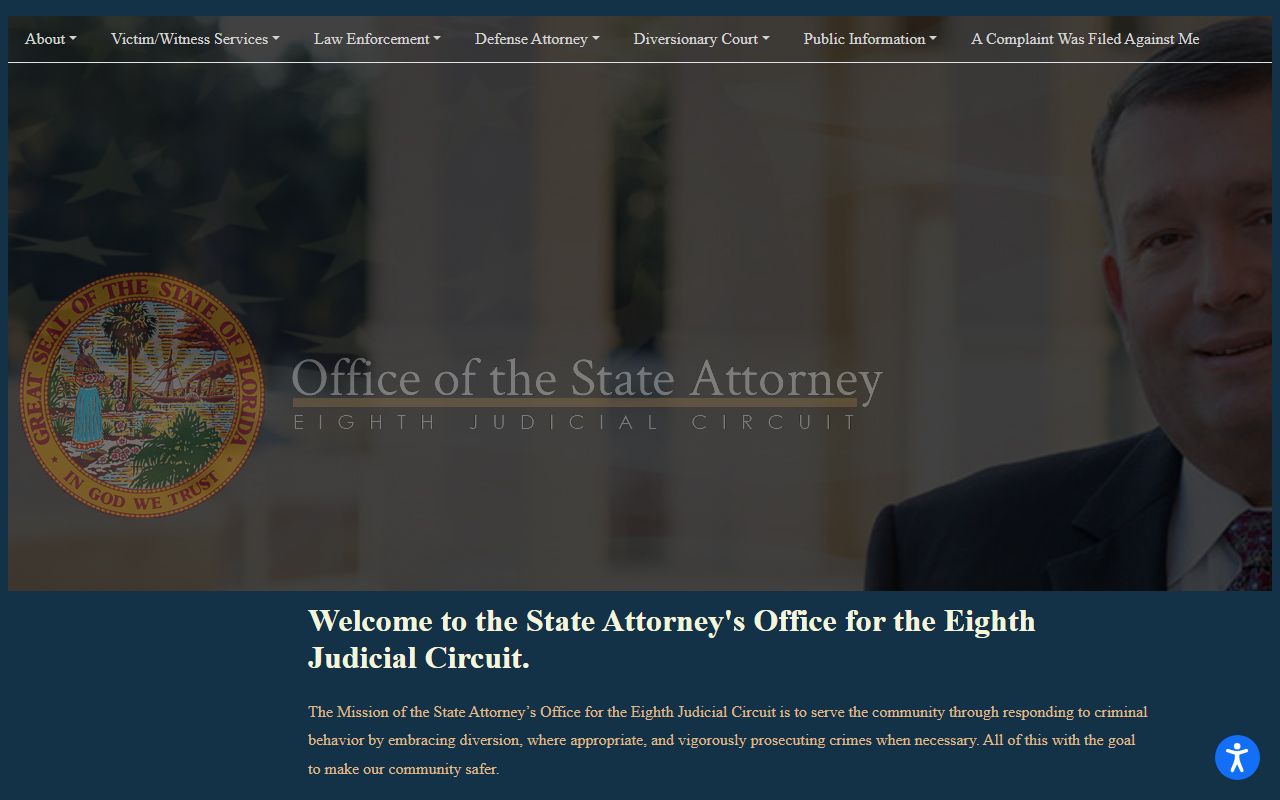
Once the State Attorney files, every later change to the charge shows on the Baker County Clerk or OCRS docket. That is where amendments, dropped counts, and final outcomes get recorded.
Note: the booking charge on the jail roster is not the filed charge, so always confirm the real counts in the court case rather than the custody record.
Baker County Charge Status After an Arrest
Charges move as a case goes on. A count can be amended, reduced, added, dropped, or dismissed. The booking charge captured on the jail roster can read very differently from the charge the prosecutor finally files. The court record tracks each shift with a status label. A few core terms come up again and again in Baker County case dockets, and each one carries a plain meaning.
| Status | What It Means |
|---|---|
| Pending | The charge is filed and the case is still open. No final result has been entered yet. |
| Amended / Reduced | The prosecutor or court changed the charge, often to a lesser count or a different statute. |
| Dismissed | The charge or case was thrown out and is no longer being pursued. |
| Nolle Prosequi | The prosecutor formally chose not to pursue the charge. It drops out of the case. |
Other words round out the picture. An arrest charge is the count logged at booking, often on probable cause alone. A filed charge is the count the State Attorney actually brings. A conviction is a settled outcome by plea or verdict. A disposition is the final status of a charge or the whole case. Reading these labels in the right order keeps a reader from confusing a raw arrest charge with a proven result.
Bond and Release After a Baker County Arrest
Bond is the money or terms a court sets so a person can leave jail while the case runs. In Baker County the bond and early court events are set by the court, often at a first appearance soon after booking. The jail feed may not display the court date or the bond amount. Baker's official pages do not publish a local bond fee or payment schedule, so the exact posting method must be confirmed by phone or court. For jail and charge questions on an ordinary county inmate, the sheriff directs callers to 904-259-3311, then on to the Clerk or OCRS for the case itself.
| Bond Type | How It Works |
|---|---|
| Cash Bond | The full amount is posted in cash or certified funds to secure release. |
| Surety Bond | A licensed bail agent posts the bond for a fee under Florida bail-agent rules. |
| PR / Own Recognizance | The court releases the person on a written promise to appear, usually with conditions, and no cash security. |
| No-Bond Hold | A court order or agency hold blocks release, common with warrants, probation, ICE, or U.S. Marshals custody. |
Custody type changes who controls the bond. For a held immigration detainee, the sheriff routes bond questions to the Department of Homeland Security Jacksonville office at 904-288-4600. The sheriff does not hold current charges or bond terms for people kept under U.S. Marshals or ICE authority, so a county bond figure will not apply to them.
Warrants That Lead to a Baker County Arrest
Many arrests start with a warrant. A judge signs an arrest warrant or a bench warrant, and the next contact with law enforcement can end in booking. Baker County does not run a public online warrant-search tool. The sheriff's app and site list inmate search, arrest reports, and court search, but no warrant list. So the court side is the better place to look. Bench-warrant activity tied to a missed court date or a case can show on the Baker County Clerk or OCRS docket for that case.
To check whether a warrant has already put someone in custody, use the sheriff inmate search or call 904-259-3311. Florida does not offer one public statewide warrant lookup in the sources reviewed, and FDLE criminal-history products are separate from local warrant clearance. Do not walk into the jail blindly to settle a warrant. Confirm the bond or no-bond status first, then work through the court, the clerk, or an attorney.
Note: a bench warrant after a missed hearing often surfaces on the court docket before any new booking appears, so the case file is worth checking early.
Charges vs. Convictions in Court Records
An arrest and a charge are not a conviction. This is the single most misread point in court records after an arrest. A charge is an accusation. A conviction is a settled result by plea or verdict. A person can be arrested, charged, and then cleared, with the case dropped or dismissed. Both the charge and the conviction are public, but they sit at very different stages and carry very different weight.
| Charge | Conviction | |
|---|---|---|
| Stage | Accusation | Verdict or plea |
| Burden of Proof | Probable cause | Beyond reasonable doubt |
| Public Record | Yes | Yes |
Read the disposition before you judge an outcome. A pending charge proves nothing on its own. Only the final disposition tells you whether the count ended in a conviction, a dismissal, or a nolle prosequi. The court file holds that answer, while the jail roster never will.
Sealed vs. Expunged Court Records After an Arrest
Florida law lets some people clear a record after a dismissal or an eligible disposition. Two paths exist, and they are not the same. Sealing hides the record from the public while the record still exists. Expunction goes further and orders the record destroyed, so it is treated as if it never happened. Sealing falls under section 943.059, Florida Statutes. Expunction falls under section 943.0585. Each path has strict eligibility rules and a court order is required.
| Sealed | Expunged | |
|---|---|---|
| Visibility | Hidden from public | Destroyed / treated as never existed |
| Law Enforcement | Limited access | Very limited |
| Eligibility | Per Florida Statute 943.059 | Per Florida Statute 943.0585 |
You can read the rules in full at the Florida sealing statute, section 943.059 and the Florida expunction statute, section 943.0585. The county should not be assumed to pull a record on its own. A qualifying court order drives the change, and the relief flows from the court, not the jail.
Statewide Criminal History and Public Records Law
One local docket is not a full criminal history. A Baker County case search shows that county's files. A statewide history is a separate product handled by the Florida Department of Law Enforcement. Its release is governed by section 943.053, Florida Statutes, which controls how FDLE shares criminal-history information. That is a different track from a clerk docket, and it follows its own request and fee rules.
Public access starts with Florida's open-records law. Court records and most arrest records are public under the Florida Public Records Act, Chapter 119. Booking records, arrest reports, and case files fall under that baseline access, though exemptions and redactions still apply. For records that are not online, the sheriff's Public Records Request form is the local channel for booking-side documents, while the clerk handles court file copies.
You can review the statutes at the Florida Public Records Act, Chapter 119 and the FDLE criminal-history dissemination statute, section 943.053. Both shape what you can pull and how the data may be used.
Background Check Considerations
A casual court lookup is not a formal background check. Pulling a Baker County case to read the charges and the disposition is a public-records use. A formal screening for a job, a loan, or a rental is different. That kind of report falls under the Fair Credit Reporting Act, and it must come from a regulated consumer reporting agency that follows the law's notice and accuracy rules.
Important: This site is not a consumer reporting agency under the FCRA, and nothing here may be used to decide credit, jobs, housing, or insurance.
Restricted Court Records After an Arrest in Baker County
Not every record after an arrest is open. Some files are restricted by law. Juvenile records carry tight access limits. Sealed charges drop out of public view, and expunged records are treated as gone. A dismissed charge that ends with adjudication withheld can still be restricted from broad release in some settings. An open investigation may be exempt from disclosure while it is active. When a file is missing from the public docket, one of these limits is often the reason.
Victims have a support path too. The Baker County Sheriff's Office runs a Victim Advocate who helps with case-status questions and court accompaniment. The advocate is Jodi Altman, reachable at 904-653-6021 or Jodi.Altman@Bakerso.com. Custody-notification signups through VINELink connect to the same Baker agency feed, which carries the FLSWVINE and FLBAKERSO identifiers used for alerts.
Note: a record that does not appear in a public search is not always erased, since juvenile, sealed, or pending-investigation rules can simply hide it from open access.